
Mastering the Art of Good Graphic Design for Your Website

In the digital age, where visual appeal plays a pivotal role in capturing and retaining audience attention, mastering the art of good graphic design for your website is paramount. A well-designed website not only enhances user experience but also conveys credibility and professionalism, ultimately driving engagement and conversions. In this guide, we delve into the fundamentals of effective graphic design and provide actionable tips to optimize your website’s visual aesthetics for SEO success.

Understanding the Importance of Graphic Design for Websites

  1. First Impressions Matter: Your website is often the first point of contact with potential customers. A visually striking design creates a positive first impression, encouraging visitors to explore further.
  2. Brand Identity: Consistent branding elements, such as colour schemes, typography, and imagery, reinforce your brand identity and foster brand recognition across various online channels.
  3. User Experience (UX): Intuitive navigation, clear messaging, and visually appealing layouts enhance UX, leading to increased engagement and lower bounce rates.

Key Elements of Good Graphic Design for Websites

  1. Typography: Choose fonts that are easy to read and align with your brand’s personality. Maintain consistency in font styles and sizes to create a cohesive look throughout your website.
  2. Colour Palette: Select a harmonious colour scheme that reflects your brand’s ethos and resonates with your target audience. Consider the psychological impact of colors and use them strategically to evoke desired emotions.
  3. Imagery: High-quality images and graphics not only enhance visual appeal but also convey your brand’s story effectively. Optimize images for web to ensure fast loading times without compromising quality.
  4. Whitespace: Utilize whitespace strategically to improve readability and draw attention to key elements on your website. A clutter-free layout enhances user focus and comprehension.
  5. Consistency: Maintain consistency in design elements, such as button styles, iconography, and spacing, across all pages of your website. Consistency fosters familiarity and instils trust in your audience.

SEO Optimization Strategies for Graphic Design

  1. Image Optimization: Optimize image file names, alt text, and descriptions with relevant keywords to improve visibility in search engine results. Compress images to reduce file sizes and enhance page loading speed.
  2. Responsive Design: Ensure your website is mobile-friendly and adapts seamlessly to various screen sizes. Responsive design not only enhances user experience but also boosts search engine rankings, as mobile-friendliness is a key ranking factor.
  3. Structured Data Markup: Implement structured data markup, such as Schema.org, to provide search engines with additional context about your website’s content. This can improve the likelihood of your site appearing in rich snippets and other enhanced search results.
  4. Page Speed Optimization: Minimize server response times, leverage browser caching, and utilize content delivery networks (CDNs) to improve page loading speed. Faster websites are favoured by search engines and tend to rank higher in search results.
  5. Optimized Metadata: Craft compelling meta titles and descriptions that accurately reflect the content of each web page. Incorporate relevant keywords to improve click-through rates and signal relevance to search engines.

Conclusion

In conclusion, the art of good graphic design is a multifaceted endeavour that goes beyond aesthetics. By incorporating design principles that prioritize user experience and brand consistency, coupled with SEO optimization strategies, you can create a visually captivating website that not only attracts visitors but also ranks well in search engine results. Remember, effective graphic design is an ongoing process that requires continuous refinement and adaptation to evolving trends and technologies. Embrace creativity, stay informed, and let your website design be a reflection of your brand’s uniqueness and value proposition.
Maximizing your Website’s Visibility: A Guide to Off-Page SEO

Off-page SEO refers to all the activities that occur outside of a website to improve its ranking on search engine results pages (SERPs). The main aim of off-page SEO is to increase the visibility and credibility of a website to search engines, which will ultimately lead to higher search engine rankings.

Here are the key components of off-page SEO:

  • Link Building: One of the most important aspects of off-page SEO is link building. Search engines use links to crawl the web and understand the relationship between different pages. The more high-quality links a website has pointing to it, the more authoritative it will appear to search engines, which will result in higher search engine rankings.
  • Social Media Marketing: Social media platforms are great for promoting your website and building backlinks. Regularly sharing quality content and engaging with your audience on social media can help increase your website’s visibility and drive more traffic to your site.
  • Content Marketing: Off-page SEO also involves creating and promoting high-quality, relevant content on other websites to drive traffic back to your own website. This can be in the form of guest blogging, infographics, or video vontent.
  • Brand Mentions: Brand mentions refer to instances when your brand is mentioned online, but not necessarily linked to your website. Search engines view these mentions as a sign of your brand’s popularity and relevance, which can help improve your search engine rankings.
  • Online reputation management: Off-page SEO also involves managing your online reputation, which refers to how your brand is perceived online. This can include monitoring what people are saying about your brand on social media, forums, and review sites, and responding to any feedback (negative or positive) in a professional manner.

In conclusion, off-page SEO is an important aspect of search engine optimisation that focuses on improving a website’s visibility and credibility to search engines. A strong off-page SEO strategy should include link building, social media marketing, content marketing, brand mentions, and good online reputation management.

On-page Optimisation: Techniques for optimising individual web pages for search engines

On-page optimization is a crucial aspect of search engine optimization (SEO) that involves optimising individual web pages to rank higher and earn more relevant traffic in search engine results. In this article, we will explore some of the most effective on-page optimization techniques that can help you boost your website’s visibility in search engine results.

Title tags: The title tag is the text that appears in the browser’s tab when a page is opened. It’s also the text that appears in search engine results as the title of a page. Title tags should be unique and descriptive, and should include the primary keyword for the page.

Meta descriptions: The meta description is the text that appears under the title in search engine results. It should be a concise and compelling summary of what the page is about, and should include the primary keyword for the page.

Headings: Headings, or H tags, are used to structure the content on a page. They range from H1 (the most important) to H6 (the least important). Each page should have only one H1 heading, which should include the primary keyword for the page.

Content: Content is the most important factor for on-page optimization. It should be high-quality, relevant, and informative. It should also include the primary keyword for the page in the first 100 words, as well as in the last 100 words.

Images: Images can help to break up text and make a page more visually appealing. They should be optimised with descriptive file names, alt tags, and captions.

Internal linking: Internal linking is the practice of linking to other pages on your own website. It helps to distribute link juice and establish the hierarchy of your website’s pages.

URL structure: URLs should be short, descriptive, and include the primary keyword for the page.

Mobile-friendly design: With the increasing number of users browsing the web on mobile devices, it’s essential to ensure that your website is mobile-friendly. Google has a mobile-first index, meaning that it will consider the mobile version of your website for indexing and ranking.

In conclusion, on-page optimization is a crucial aspect of SEO that involves optimising individual web pages to rank higher in search engine results. By implementing these techniques, you can increase the visibility and relevance of your website, and ultimately drive more relevant traffic to your pages.

Keyword research: How to find the right keywords to target in your SEO strategy

Keyword research is a crucial part of any SEO strategy. By identifying the right keywords to target, you can ensure that your website ranks for the terms that your target audience is searching for. There are several steps you can take to find the right keywords for your website.

First, start by making a list of the products or services you offer, as well as the topics related to your business. These will be the seed keywords for your research. Next, use a keyword research tool like Google’s Keyword Planner or Ahrefs to expand on your list of seed keywords and find additional related keywords. These tools will show you the search volume and competition for each keyword, which can help you prioritise the most relevant and feasible keywords to target.

In addition to using keyword research tools, you can also get inspiration for keywords by looking at your competitors’ websites and seeing what terms they are ranking for. You can use a tool like SEMrush to see the keywords that your competitors are ranking for and find opportunities to target similar keywords. By conducting thorough keyword research, you can identify the terms that are most likely to drive qualified traffic to your website.

Once you’ve compiled a list of potential keywords, it’s important to evaluate them to determine which ones are worth targeting. Here are some factors to consider when evaluating keywords:

  1. Relevance: Make sure the keywords you choose are relevant to your business and the products or services you offer.
  2. Search volume: Consider the number of people who are searching for each keyword. Keywords with high search volume are generally more competitive, but they also have the potential to drive more traffic to your website.
  3. Competition: Look at the competition for each keyword to see how difficult it will be to rank for that term. You can use a tool like the Google AdWords Keyword Planner to see the competition level for each keyword.
  4. Commercial intent: Consider the intent behind each keyword. Are people searching for this term because they are looking to buy something, or are they just looking for information? Keywords with high commercial intent are generally more valuable because they are more likely to lead to sales.

By evaluating your keywords based on these factors, you can determine which ones are worth targeting and prioritize them in your SEO strategy.

Once you’ve identified the most relevant and valuable keywords to target, the next step is to incorporate them into your website’s content and meta data. Here are some ways to use your keywords effectively:

Use keywords in your page titles and headings: The titles of your web pages and the headings within those pages are important elements that search engines use to understand the content of your site. By including your target keywords in these elements, you can signal to search engines what your pages are about and help them rank for those keywords.

Use keywords in your page content: Incorporating your target keywords naturally into the body of your web pages can also help improve your search engine rankings. Be sure to use your keywords sparingly and in a way that makes sense in the context of your content.

Use keywords in your meta descriptions: The meta descriptions of your web pages are short descriptions that appear in the search results below the page titles. These descriptions should include your target keywords and provide a brief overview of what the page is about. By including keywords in your meta descriptions, you can help increase the chances that your pages will be clicked on in the search results.

By using your target keywords effectively in your website’s content and metadata, you can help improve your search engine rankings and drive more qualified traffic to your site.

Keyword research is an ongoing process and it’s important to regularly review and update your keyword strategy as your business and the search landscape evolves. By staying up-to-date on the latest trends and techniques and continuously fine-tuning your keyword targeting, you can ensure that your website is always optimised for success.

By following the steps outlined in this article, you can conduct thorough keyword research and develop an effective keyword strategy to improve your search engine rankings and drive qualified traffic to your website. If you’re looking for additional guidance or support with your SEO efforts, consider seeking out the services of a professional SEO agency. A team of experts can help you conduct keyword research, optimise your website, and develop a customised SEO strategy that meets the specific needs of your business. Don’t wait – start improving your search engine rankings today and watch your business grow.

If you’re looking for good tools, both free and paid, stay tuned for our next article. In fact, why not subscribe to our mailing list and get notified of each article as and when they update?

SEO – What is Authority and Why does it matter?

SEO authority is an important concept for anyone looking to improve their website’s ranking in search engine results pages (SERPs). But what exactly is SEO authority and how is it measured?

In simple terms, SEO authority is a measure of the strength or quality of a website’s search engine optimization. It is determined by a variety of factors, including the quality and quantity of links pointing to the website, the relevance of the content on the website to the search terms being used, and the overall authority and credibility of the website or domain.

One of the most important factors in determining a website’s SEO authority is the number and quality of links pointing to it. These links, known as “backlinks,” act as a vote of confidence for the website and can help to improve its ranking in the SERPs. However, not all backlinks are created equal. Links from high-quality, authoritative websites carry more weight than those from low-quality or spammy websites.

Another important factor is the relevance of the content on the website to the search terms being used. Search engines want to provide users with the most relevant and useful results, so websites with content that closely matches the search terms being used are more likely to rank higher. This is why it’s important to use relevant keywords and phrases in your website’s content, as well as to regularly update and refresh that content to keep it fresh and relevant.

Finally, the overall authority and credibility of the website or domain can also play a role in determining its SEO authority. Websites that have been around for a long time and have a strong reputation are generally considered more trustworthy and authoritative, which can help to boost their ranking in the SERPs.

Here are some good first steps for a small business to establish SEO authority:

  1. Claim your Google My Business listing: This will allow you to appear in Google Maps and local search results. Be sure to include accurate and up-to-date information about your business, such as your address, phone number, and hours of operation.
  2. Optimise your website for local SEO: Include your location in the title and meta tags of your website, as well as in the content of your pages. This will help search engines understand that your business is local.
  3. Get listed in online directories: In addition to Google My Business, be sure to get listed in other online directories, such as Yelp, Yellow Pages, and local chamber of commerce websites.
  4. Encourage customer reviews: Online reviews can help to improve your local SEO and build credibility for your business. Encourage customers to leave reviews on your Google My Business listing and other review websites.
  5. Build local backlinks: Obtain backlinks from local websites, such as the websites of local organisations, events, and news outlets. These backlinks can help to improve the credibility and authority of your website.
  6. Optimise your website for mobile: More and more people are using their smartphones to search for local businesses, so it’s important to make sure your website is mobile-friendly.

In conclusion, SEO authority is a crucial factor in determining a website’s ranking in the SERPs. By focusing on building high-quality backlinks, creating relevant and useful content, and maintaining a strong reputation, you can improve your website’s SEO authority and increase its chances of ranking well in the search results.

Mastering the Art of SEO

Are you just starting your business and feeling overwhelmed by the hidden world of SEO? Look no further! In this article, we’ll focus on general SEO principles for standard websites, blogs, and social media. E-Commerce SEO will be covered in a future article.

As a small business owner, you know that location is crucial when it comes to SEO. Think about it – you’re walking through Newcastle-upon-Tyne and you want to grab a slice of pizza. You open your phone and search for “pizza places near me” or “pizza places in Newcastle.” Google brings up the search engine results page (SERP) and you scroll down to the top results under the Google Maps snippet. The top results are the golden standard for any business with an online presence. In fact, ranking on the first page of Google is the ultimate goal. But let’s be real – there are some results pages that you just won’t be able to beat, like Amazon or TripAdvisor, depending on your industry. So how do you secure a spot on that coveted first page?

First and foremost, it’s important to establish authority in your field. This can be achieved through high-quality content, good customer service, and online reviews. Another factor to consider is local SEO. Ranking locally is a great way to build up your business’s presence in Google’s search algorithm. And don’t forget – with Google’s location tracking capabilities, you may not even have to search for “near me” when looking for a specific type of business. However, including the location name in your search terms can still be beneficial.

Now let’s say you’re in the e-commerce business, selling combat sports equipment like boxing gloves, MMA gloves, punching bags, and weights. The top listings for this industry are likely to be big brands like Sports Direct, Amazon, Venum, Adidas, Tatami, RDX, and Argos (in the UK, at least!). It can be intimidating to go up against these heavy hitters, but with a solid SEO strategy, you can still make your mark.

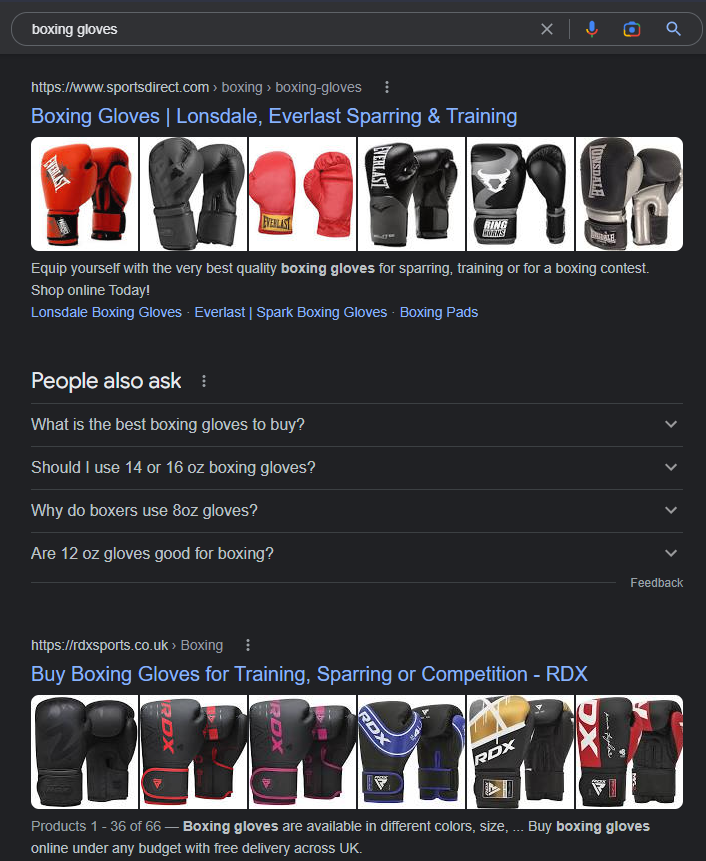
One of the first things you should do is conduct a quick Google search for your target keywords and see what the top results are. This will give you an idea of the competition you’re up against and what kind of optimization strategies they are using. It’s important to remember that good research into SEO is crucial, especially if your business has a lot of competition.

What a SERP (Search Engine Results Page) looks like with the above mentioned example of Boxing Gloves. Note the 'people also ask' section.

But don’t worry – we’re not advocating for plagiarism here! What we are advocating for is taking a look at your most successful competition and considering what they are doing. As a small business owner, you have to balance a lot more than just SEO, so it’s helpful to see what’s working for others in your industry. Of course, it’s important to stay true to your own brand and values, but there’s no harm in taking some inspiration from the big players.

What the big players have, however, is ‘Authority’….

In our next article, we’ll delve deeper into the first principle of SEO: establishing authority. Stay tuned!